
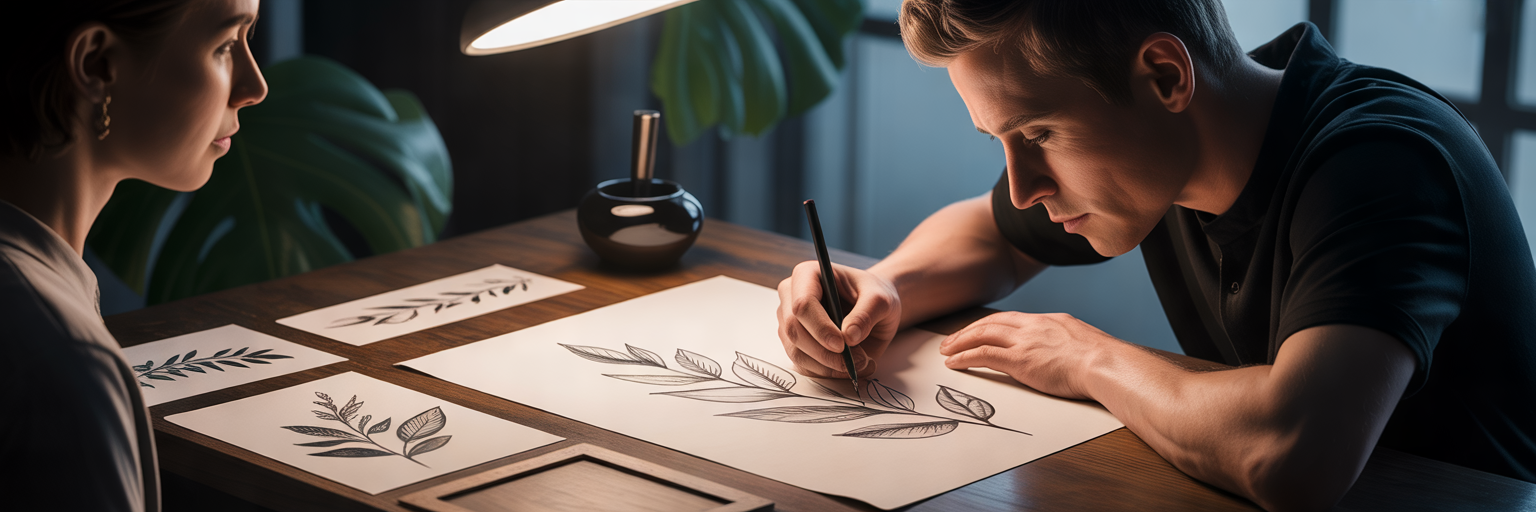
Single needle tattooing emerged in the 1970s when fine line pioneers began adapting technical illustration sensibilities to skin, proving that subtle restraint could hold as much emotional weight as traditional bold ink. How can you condense a multi-layered personal milestone into a few intentional lines without losing the heart of your story? Planning a custom minimalist tattoo requires emotional preparation and thoughtful curation long before the first sketch begins.
Distilling Complex Memories Into a Minimalist Tattoo
Achieving a timeless piece relies on distillation rather than simple deletion. When clients attempt to shrink a complex painting into a tiny space, the narrative quickly becomes muddled. By distilling the emotion to its essence, your story remains intact despite having far fewer lines.
The Single Sentence Narrative Exercise
Before visiting the studio, write your personal milestone as a single, focused sentence to define the exact emotional stakes. Clients often seek to summarize major life chapters like welcoming a child, a process we explore in our guide on choosing a tattoo style for commemorating parenthood. This exercise transforms broad memories into focused concepts, generating meaningful small tattoo ideas that feel personal rather than cluttered.
Selecting Your Visual Recognition Anchors
Once your core sentence is clear, work with your artist to protect one to three visual recognition anchors. These specific objects, contours, or motifs carry the weight of your narrative without crowding the skin. Many professionals and diplomats visiting our studio balance a desire for understated elegance in corporate environments with the need for a rich, expressive tribute. Anchoring your concept in a single silhouette satisfies both requirements. Ultimately, an enduring piece starts with emotional clarity before the stencil ever touches your skin.
Choosing Personal Symbols Over Generic Flash

With your emotional core defined, the collaborative process shifts toward selecting concrete imagery and cultural nuances. Literal depictions and overused universal flash clichés like standard infinity loops, generic pocket watches, or stock compasses rarely capture the texture of a lived journey. Bespoke artistry thrives on details that belong exclusively to you.
Uncovering Private Motifs From Lived Experience
Translating your history into subtle linework requires looking closely at the physical artifacts of your life. Consider these methods for uncovering private symbolism:
- Trace the exact botanical silhouette of a plant from your childhood garden.
- Isolate a distinct architectural arch from a transformative travel destination.
- Adapt the delicate contour of a cherished family heirloom or piece of jewelry.
- Capture the authentic soundwave of a loved one's laughter.
- Extract a single topographic contour line from a mountain or coastline that shaped your perspective.
This degree of symbolic abstraction keeps your motif discreet enough for formal settings while ensuring you feel an immediate rush of recognition every time you see it.
Harmonizing Eastern and Western Artistic Sensibilities
Personal symbols frequently draw from family ancestry and regional roots, a theme we examine in our insights on cultural heritage tattoos for honoring your roots. Blending Eastern and Western artistic sensibilities is a sought-after approach for anyone planning a custom minimalist tattoo Singapore collectors admire. Pairing a single fluid calligraphic brushstroke with geometric micro-realism creates a quiet cultural statement, an approach detailed in our exploration of fusion tattoos blending Eastern and Western styles. Symbols gain lasting artistic power when rooted in personal history rather than search engine templates.
Compositional Techniques for Visual Hierarchy and Clarity
Selecting personal motifs provides the raw vocabulary, but spatial geometry and body contours determine how clearly that story reads. An experienced artistic director approaches the body as a three-dimensional canvas where proportion dictates legibility.
Using Negative Space and the 20 to 40 Percent Rule
In a refined fine line tattoo design, negative space acts as an intentional compositional tool rather than an empty void. Leaving uninked skin allows your natural tone to form implied boundaries and breathing room around delicate ink. To establish clear visual hierarchy in custom linework, we enlarge the primary narrative anchor by 20 to 40 percent relative to supporting secondary details. This proportional shift ensures the eye immediately grasps the focal point of your story without visual confusion.
Anatomical Flow and the Squint Test
Seasoned artists verify layout strength using the practical squint test, viewing the stencil from across the room with narrowed eyes to confirm the silhouette retains its distinct identity. Natural anatomical flow also dictates composition, which is why a vertical narrative meant for the inner forearm requires different spatial pacing than a horizontal motif along the collarbone, as outlined in our resource on selecting the best tattoo placement for storytelling designs.
Minimalist Compositional Adjustments by Anatomical Placement
| Anatomical Zone | Skin Movement and Tension | Ideal Narrative Orientation | Recommended Negative Space Ratio |
|---|---|---|---|
| Inner Forearm | Moderate rotational twist during wrist motion | Vertical linear flow aligned with radius bone | 40% open skin to prevent visual crowding during rotation |
| Collarbone (Clavicle) | Low skin stretch over stable bone structure | Horizontal asymmetric sweep following bone contour | 50% open skin to let skeletal structure frame the motif |
| Lateral Ribcage | High expansion and contraction with breathing | Diagonal organic flow curving with intercostal muscles | 60% open skin to maintain clarity across torso movement |
| Outer Ankle | High tendon flexion and constant footwear friction | Compact circular or vertical anchor above joint line | 45% open skin with simplified secondary contours |
These compositional parameters reflect standard anatomical mechanics and professional custom tattooing standards regarding skin elasticity, joint articulation, and long-term visual legibility. As muscles contract and joints rotate, skin tension shifts the visual pacing of your ink. Deliberate spacing and proportional hierarchy separate bespoke art from a flat sketch.
Technical Realities of Fine-Line Aging and Collaborating With Your Artist
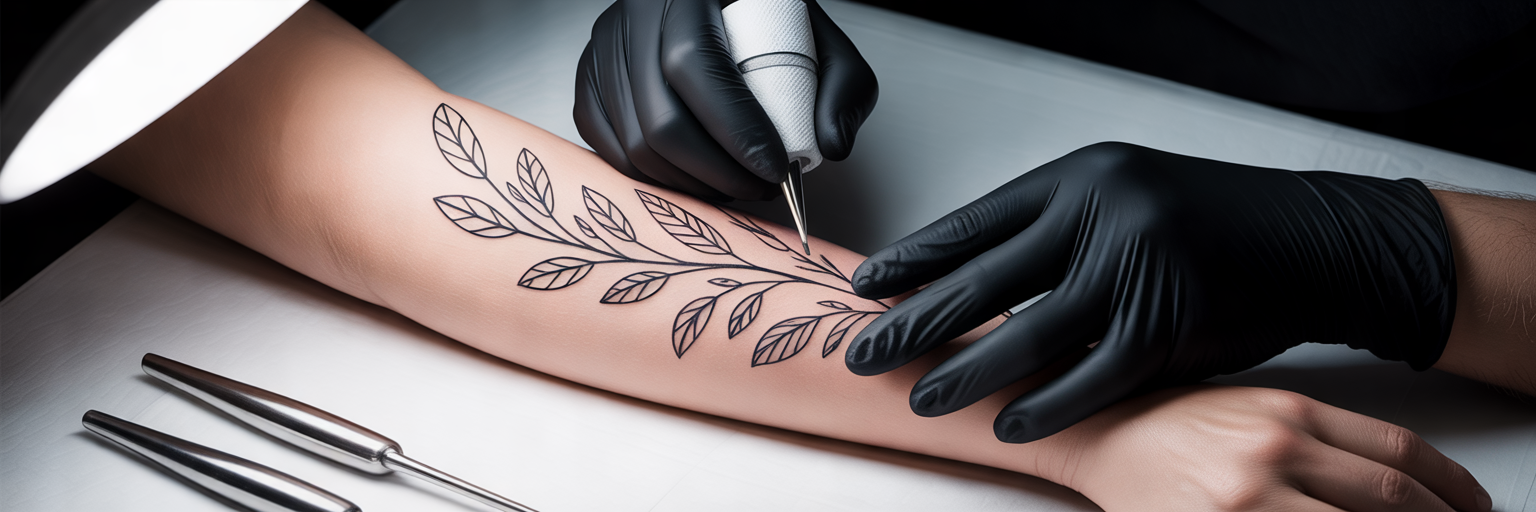
Even the most balanced composition must respect the biological realities of living skin. Translating a delicate paper drawing into permanent body art requires open collaboration between you and a veteran practitioner who understands how ink behaves over decades.
Dermis Ink Settling and Climate Considerations
Over the years, ink settles within the dermis as collagen naturally shifts and regenerates. Micro-details placed too closely together will eventually soften and merge into an indistinct blur. Much like evaluating how long car tires last based on rubber compound, road friction, and maintenance, the long-term crispness of fine linework depends on foundational execution, daily environmental exposure, and ongoing care. Calibrating the minimum workable scale and proper needle grouping prevents premature blurring. In humid, high-UV equatorial climates like Singapore, diligent sun protection is essential to keep delicate lines sharp, a topic we cover in our guide to maintaining tattoo vibrancy in the tropics. Booking a bespoke tattoo consultation at our Memory Lane Tattoo Studio connects you with artistic director Apple Qu, who brings over 20 years of experience in fine-line artistry, hyper-realism, and complex cover-ups to help local residents and international visitors translate raw emotional concepts into timeless skin compositions.
Questions to Ask During Your Stencil Fitting
During your live fitting, evaluate the stencil in a full-length mirror and ask your artist these essential questions to align your narrative goals with technical longevity:
- How can we adjust the line weight contrast between the primary anchor and secondary details so the focal point stays sharp?
- Are the minimum gap tolerances between these parallel lines wide enough to prevent merging as the ink settles over five to ten years?
- How does joint flexion or muscle rotation distort this silhouette when my arm or leg is in natural motion?
- Should we increase the overall scale slightly to preserve the interior negative space of the smallest motifs?
- How will this specific placement age over a ten-year projection given my daily sun exposure and lifestyle?
Trusting an experienced artist to calibrate scale and line weight ensures your complex story remains legible and expressive for decades.