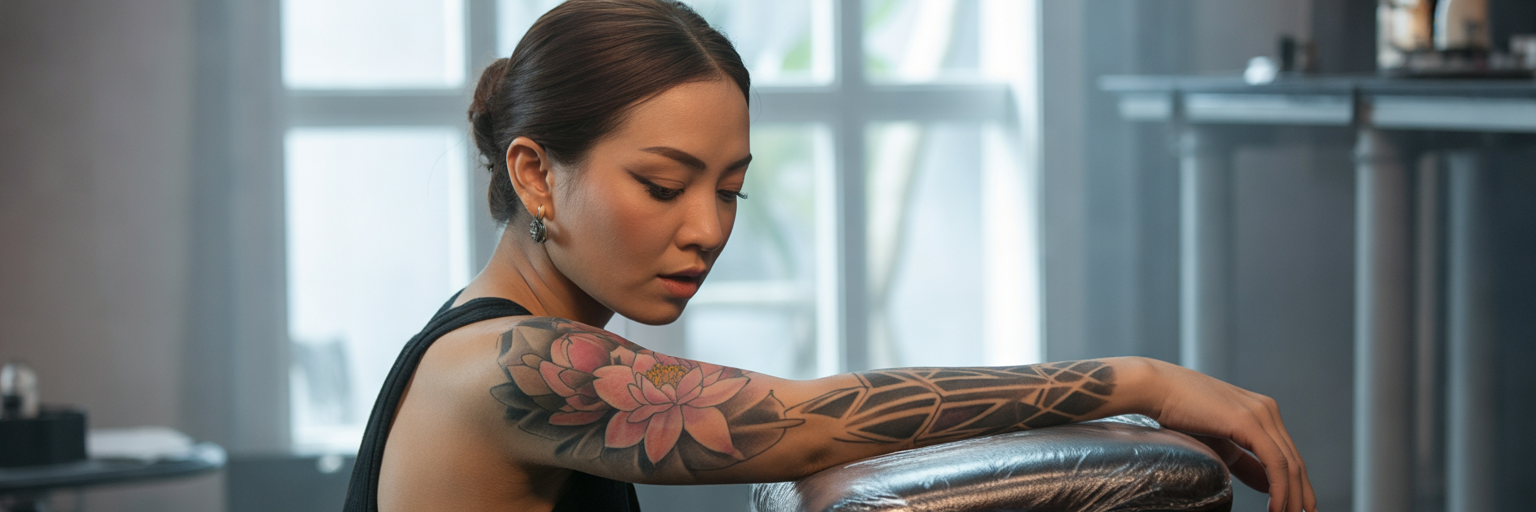
Archaeological discoveries of the 5,300 year old Iceman Otzi prove that humans have used body markings to document personal history for millennia. When your life story spans multiple continents or heritages, translating that dual identity onto skin requires thoughtful artistic choreography. Planning a fusion tattoo allows you to weave these distinct chapters into one harmonious piece of wearable art.
Understanding the Art of the Fusion Tattoo
Many people initially approach a multicultural piece by gathering favorite icons from different backgrounds, hoping to place them side by side. True artistic synergy requires a deeper approach.
Moving Beyond a Simple Symbol Collage
Placing a Celtic knot directly next to a Chinese dragon without shared artistic rules often looks like a page from a sticker book. A cohesive fusion tattoo avoids this visual disconnection by merging distinct traditions into a single, unified narrative. Rather than forcing two separate concepts to share the same patch of skin, we look for the underlying emotional thread that connects your heritage or personal milestones. As we explore in our studio guide on blending Eastern and Western styles, the magic happens when one tradition informs the movement and rhythm of the other.
Why East Meets West Storytelling Resonates in Singapore
Living in a global crossroads like Singapore shapes how we view identity. Cross cultural marriages, expat journeys, and blended family lineages are part of everyday life here. Because so many residents carry memories from multiple corners of the globe, an East meets West tattoo naturally reflects the local experience. Achieving this balance relies on the core philosophy of bespoke tattoo artistry, which prioritizes structural harmony, shared pattern logic, and early collaborative planning between you and your artist. Ultimately, a timeless multicultural piece relies on intentional storytelling and cohesive artistic rules rather than squeezing multiple cultural icons into one space.
Establishing Cultural Respect and Symbolic Boundaries
Once your conceptual story is clear, the next step involves examining the historical roots of your chosen imagery. Approaching traditional motifs with care ensures your artwork honors the cultures it represents.
Researching Sacred vs Appreciative Motifs
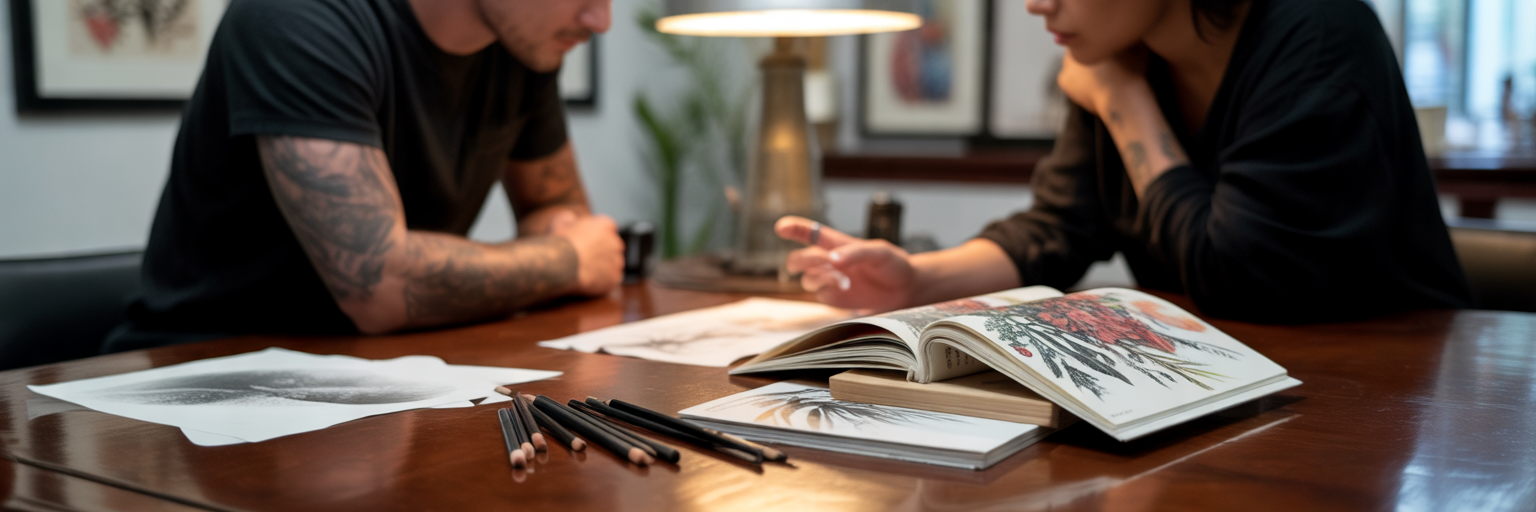
Before our pencils ever touch sketch paper, we work alongside our clients as ethical collaborators to research the history behind every symbol. A thoughtful cultural tattoo design distinguishes between appreciative artistic blending and the misuse of sacred, lineage specific, or restricted ceremonial markings. Certain Polynesian tribal patterns, indigenous family crests, or religious scripts carry earned status that should not be altered or blended casually. When you take the time to understand these boundaries, as outlined in our resource on choosing designs that reflect your cultural heritage, your creative process gains deeper authenticity.
Finding Respectful Visual Alternatives
When a specific traditional motif is off limits, you still have plenty of rich visual avenues to explore. Building a respectful, well documented design brief with your artist can follow four practical steps:
- Identify the core personal memory, geographical home, or family lineage tied to each culture so your artist understands the emotional anchor.
- Verify whether traditional patterns hold restricted ceremonial status by consulting historical archives or cultural practitioners.
- Select regional flora, native wildlife, or historic architectural geometry as open visual substitutes that evoke a sense of place without overstepping boundaries.
- Share reference photos of traditional textiles, family heirlooms, or classic ceramics to guide your artist in capturing authentic pattern rhythms.
Ethical preparation protects the integrity of the traditions involved and gives you lifelong confidence in the deeper meaning of your body art.
Compositional Hierarchy and Visual Balance
With respectful symbols selected, your artist will translate those ideas into a balanced layout. Structuring a custom design requires clear spatial rules so the eye knows exactly where to travel.
The 70/30 Dominant and Accent Rule
When two styles share equal visual weight, they often compete for attention. We solve this during the layout phase by applying the 70/30 dominant and accent rule. By assigning one cultural style as the primary structural framework at roughly 70 percent of the piece, and the second culture as a supporting visual voice at around 30 percent, the composition feels immediately grounded. Combining two ultra dense decorative traditions at full intensity can lead to visual clutter as the ink settles over the years. Introducing strategic breathing room preserves long term legibility.
Using Natural Elements as Visual Bridges
To connect your primary framework with your accent motifs, we weave in transitional elements such as ink wash, wind bars, botanical vines, or intentional negative space. Flowing water is another favorite connector in our studio. Just as outdoor enthusiasts study a guide on reading natural trout streams to understand how surface currents wrap smoothly around river stones, tattoo artists analyze organic water dynamics to build seamless transitions between contrasting cultural motifs. The table below illustrates how different compositional pairings function in practice.
Structuring Cultural Roles Using the 70/30 Hierarchy Rule
| Dominant Framework (70%) | Supporting Accent (30%) | Transitional Visual Bridge | Long Term Legibility Impact |
|---|---|---|---|
| Traditional Japanese Irezumi waves | Western botanical roses | Soft sumi ink wash and negative skin space | High contrast keeps floral details crisp against bold water |
| European neoclassical sculpture | Chinese calligraphy brushwork | Flowing silk ribbons or subtle smoke wisps | Prevents text from crowding three dimensional portrait shading |
| Celtic knotwork geometry | Southeast Asian batik floral motifs | Dotwork gradients and open skin borders | Stops dense line patterns from blurring together over time |
This breakdown is based on custom tattoo composition principles, demonstrating how assigning clear primary and secondary visual roles prevents stylistic clashes and preserves skin readability as the ink settles.
Harmonizing Line Weight, Shading, and Technique
A balanced layout sets the stage, yet the actual needle execution is what convinces the eye that two distant art forms belong together. Harmonizing texture, line weight, and color theory requires deliberate craftsmanship.
Standardizing Shading and Contrast Ratios
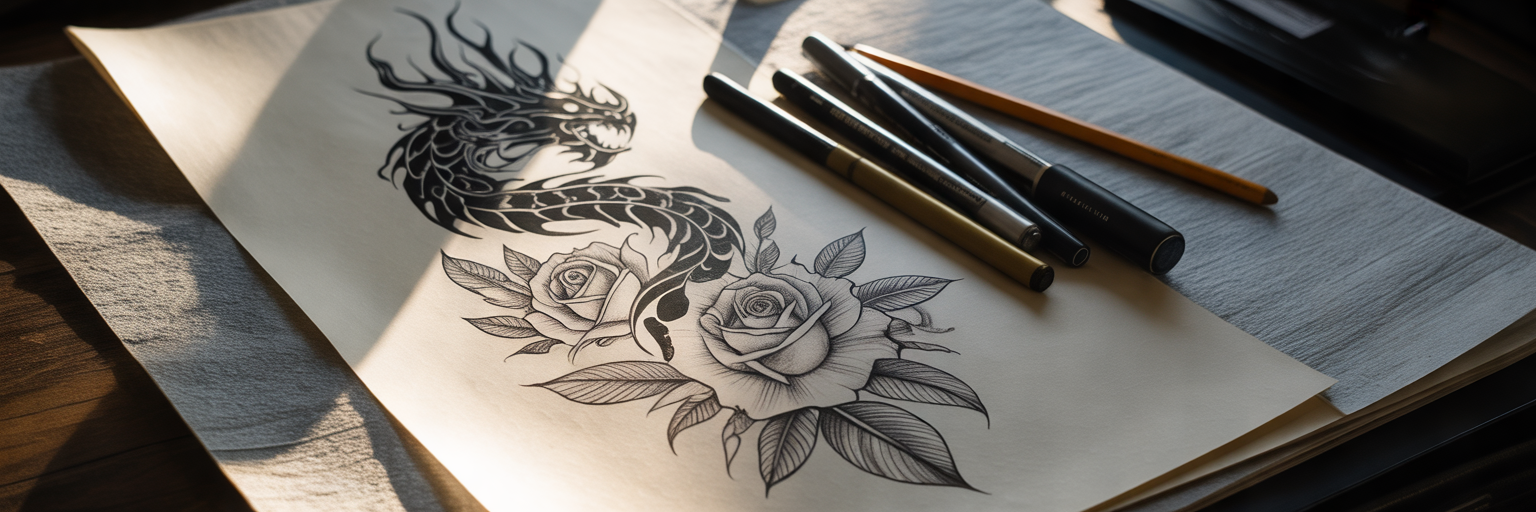
Traditional Eastern tattoos often rely on bold, flat outlines and matte color blocks, whereas Western realism favors lineless depth and subtle light gradients. Rendering both elements with their original historical techniques on the same limb can look jarring. Instead, we standardize the execution. For instance, creating a fine line fusion tattoo allows us to render both a traditional Eastern dragon and a Western architectural rose window using delicate single needle whip shading. By filtering both motifs through one technical lens, the skin reads the artwork as a unified creation.
Pairing Watercolor Brushwork with Fine Line Geometry
Some of the most captivating custom pieces pair fluid painterliness with strict mathematical structure. Expressive Chinese calligraphy strokes or soft pigment washes can weave through precise Western geometric mandalas or micro realism portraits. As we demonstrate in our article on blending watercolor techniques into fusion tattoos, fluid color splashes soften rigid lines while the geometry gives the composition a solid backbone. During execution, artists rely on four technical unification methods:
- Maintaining a consistent outline needle grouping across both cultural motifs so border weights feel intentional.
- Applying a unified black and grey contrast ratio so one cultural element does not visually overpower the other.
- Restricting the color palette to complementary tonal families rather than mixing clashing historical pigments.
- Matching surface textures through uniform dotwork stippling or smooth opaque wash gradients.
Technical consistency acts as the invisible thread that binds different cultural motifs into a single piece of fine art.
Anatomical Mapping and Collaborative Execution
The final phase of planning brings your unified design off the drawing board and onto the contours of your body. How a tattoo interacts with your physical movement is just as vital as how it looks on flat paper.
Adapting Dual Motifs to Body Contours and Cover Ups
Joints, muscle curves, and natural skin torsion dictate how a multi cultural narrative flows. When mapping a stencil, we align structural elements with your underlying anatomy so neither cultural motif distorts when you twist your arm or bend your knee. Our guide on choosing the best tattoo placement for storytelling designs explains how wrapping elements around the forearm or shoulder blade creates a natural reveal as you move. Furthermore, fusion techniques offer a brilliant solution for cover up projects. We frequently use bold traditional Eastern backgrounds, like swirling sumi clouds or deep waves, to conceal old, unwanted ink while placing delicate Western botanical or realistic details in clear, open skin right in the foreground.
Bringing Your Story to Life Through Consultation
Translating a dual heritage journey into permanent art is a deeply personal milestone that thrives on open dialogue. When you book a consultation for a custom tattoo Singapore collectors trust at Memory Lane Tattoo Studio, artistic director Apple Qu and our dedicated team sit down with you to listen to your memories, examine your skin tone, and test how different layouts wrap around your physique. Trusting this collaborative process with a versatile artist ensures your cross cultural story is honored with a piece that feels authentic, flattering, and timeless.