
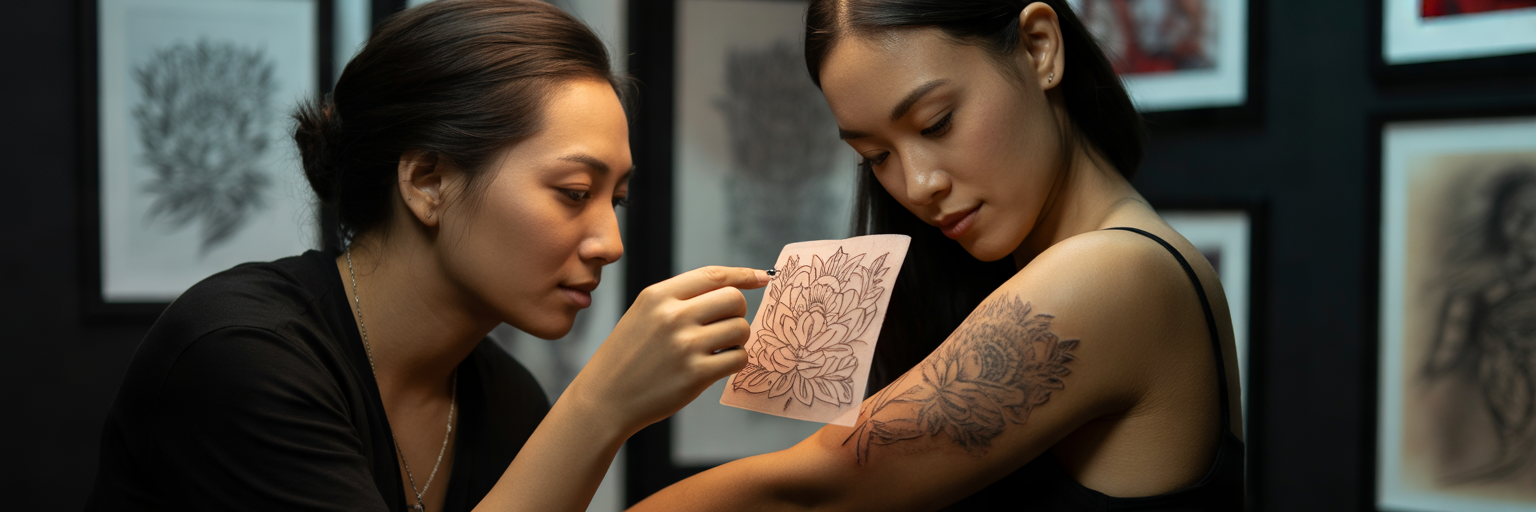
Wound healing is a complex physiological process where collagen fibers remodel over a period of up to two years before reaching permanent structural stability. Understanding this timeline is the essential first step in planning strategic tattoo placement for scar cover-ups that honor both skin health and personal storytelling.
Understanding Tattoo Placement for Scar Cover-Ups and Tissue Maturity
Reclaiming healed skin is a deeply personal milestone, and successful tattoo placement for scar cover-ups relies first on biological tissue maturity rather than purely aesthetic preferences. We view this initial assessment as a supportive partnership between you and your artist, ensuring your skin is physically ready to hold pigment safely. As we shared in our guide on transforming scars into meaningful tattoo art, honoring your skin's cellular timeline is the secret to turning past memories into enduring beauty.
The Rule of Three for Assessing Scar Readiness
Living systems have remarkable ways of detecting cellular trauma. Even in botany, research on the plant that can smell a wound demonstrates how damaged tissue releases distinct chemical signals long after an injury occurs. Human skin similarly communicates its recovery status through visible and tactile cues. Experienced artists evaluate human skin recovery using the professional rule of three criteria:
- Color stability where the tissue has faded to become lighter than or closely matched to your surrounding skin tone, free of pink or purple vascularity.
- Textural stability where the tissue has remained completely consistent in thickness, flatness, and pliability for at least six consecutive months.
- Sensory calmness where the area is entirely free of lingering pain, hypersensitivity, itching, or localized temperature fluctuations.
Why Waiting Periods Protect Pigment Retention
According to expert insights from Byrdie on the realities of tattooing over scars, waiting 12 to 24 months post-injury is the gold standard for safe ink application. When tattooing over surgical scars such as abdominoplasties or orthopedic incisions, we recommend waiting a full 18 to 24 months so deeper subdermal layers can settle. Respecting this timeline prevents ink blowouts, distorted healing, and unpredictable pigment rejection in shifting collagen networks. Patience during the healing phase provides the ultimate foundation for a safe, lasting, and meaningful piece of body art.
How Body Anatomy and Skin Movement Dictate Placement Strategy
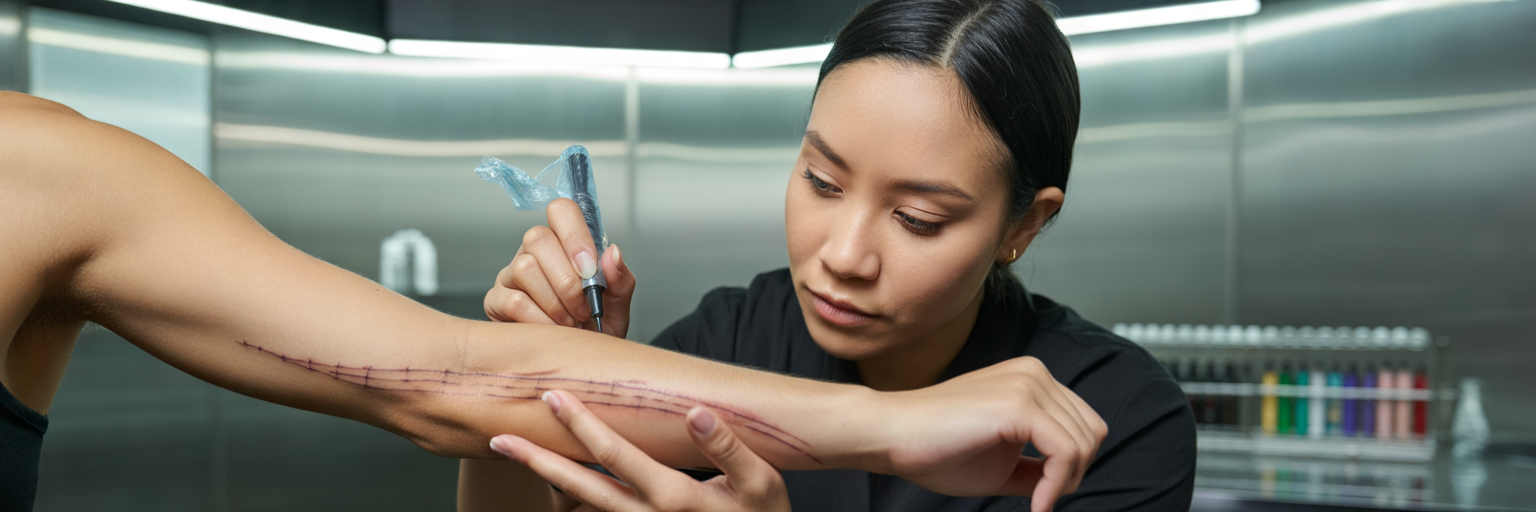
Once your tissue is fully mature, the focus shifts to how your body moves through daily life. Every client brings a unique canvas, and mapping artwork across three-dimensional contours requires a thoughtful consultation that respects anatomical mechanics and skin tension.
Comparing Stable Canvases With High-Mobility Zones
The specific anatomical location and thickness of your scar dictate the overall layout of the artwork. Stable canvases like the upper arm and outer thigh experience predictable muscle movement and minimal stretching, allowing for intricate details right near the scar border. In contrast, high-mobility or high-tension zones such as knees, elbows, and the abdomen undergo constant joint articulation and elasticity shifts. An analysis by Sortra on selecting placement and timing for scar tattoos highlights how joint mobility and tissue thickness directly impact how lines age over time. If a layout is not mapped to your natural movement, everyday stretching can warp symmetrical patterns or pull focus toward uneven dermal textures.
Extending Artwork Into Healthy Surrounding Skin
While you cannot choose where a scar is located, we can collaboratively choose how your custom cover-up tattoo design positions its focal points, borders, and negative space around the existing tissue. Extending the footprint of the artwork well beyond the scar into healthy surrounding skin creates immediate visual distraction. By anchoring bold focal points on unblemished areas, the eye follows the broader composition rather than lingering on the underlying texture. You can explore how we map flow lines across different muscle groups in our strategic guide to tattoo placement.
The table below outlines anatomical mechanics and dermal tension across major body zones, helping clients and artists evaluate how movement affects long-term layout stability.
| Anatomical Zone | Skin Tension and Mobility | Scar Tissue Behavior | Recommended Layout Strategy |
|---|---|---|---|
| Upper Arm and Outer Thigh | Low tension with predictable muscle movement | Remains relatively flat with minimal seasonal or postural stretching | Ideal for expansive focal points and balanced symmetrical compositions |
| Abdomen and Torso | Moderate to high elasticity with significant postural shifts | Surgical incisions may tether or indent when bending or twisting | Asymmetrical, flowing layouts that wrap naturally around the waistline |
| Knees, Elbows, and Ankles | High mechanical stress and constant joint articulation | Thicker, fibrous tissue prone to fading or blurring under high friction | Open negative space directly over joints with heavier detail anchored on adjacent stable skin |
| Forearm and Calf | Moderate rotational movement with firm underlying structure | Linear scars can warp straight lines during wrist or ankle rotation | Diagonal or wrapping motifs that follow natural muscle curvature |
Working in harmony with your body's natural contours always yields a more flattering result than forcing a rigid placement over uneven terrain.
Artistic Styles That Blend, Frame, or Highlight Scar Tissue
With the spatial footprint mapped to your anatomy, the next collaborative step involves selecting visual elements, line weights, and shading techniques that complement the unique surface of your skin.
Camouflaging, Framing, or Integrating the Scar
Every scar carries a different story, and we tailor our artistic approach to match how you feel about your mark. Some clients prefer fully camouflaging the tissue within dense textures so it disappears into the background. Others choose to frame the scar with surrounding motifs, leaving the raised or indented skin completely untouched by the needle. A third approach intentionally integrates the scar as a narrative feature of the artwork, such as turning a linear incision into a blooming cherry blossom branch or a bolt of light. Choosing the best tattoo style for scars depends entirely on your emotional connection to the mark and the physical topography of the dermis.
Organic Motifs and Cultural Fusion vs. Rigid Linework
Organic styles such as botanical vines, floral arrangements, watercolor washes, and soft abstract shading excel at breaking up linear scars and disguising raised or indented texture variations. We detail why these fluid compositions adapt so gracefully to uneven skin in our overview of gentle tattoo styles for covering scars. Conversely, placing rigid geometric shapes, straight fine lines, or heavy solid blackwork directly over raised keloid or hypertrophic tissue often backfires. Sharp lines easily warp over uneven topography, drawing unintended attention to surface irregularities.
At Memory Lane Tattoo Studio, led by our artistic director Apple Qu with over 20 years of experience, we address this technical challenge by blending Eastern brushwork with Western realism. As explained in our guide on the artistry of fusion tattoos, this bespoke approach offers versatile shading, delicate color gradients, and adaptable textures tailored to your personal story and skin tone. In humid climates like Singapore, where breathable healing is paramount, these lighter, layered gradients also prevent overworked skin. Flexible, flowing designs consistently adapt best to the unique topography of scarred dermis.
Evaluating Your Artist and Navigating the Technical Consultation

Translating a vision into safe, lasting body art requires an artist who understands compromised skin structure. When seeking a scar cover-up tattoo Singapore residents and international visitors can trust, the consultation process is your most valuable safeguard.
Tactile Assessment and Medical Clearance
A thorough scar consultation always prioritizes an in-person tactile evaluation before any custom sketching begins. Your artist needs to gently feel the scar depth, test skin pliability, and check for underlying tissue adherence to see how the dermis responds to stretching. You can read more about what happens during our mapping sessions in our guide on preparing for a cover-up consultation. For complex surgical reconstructions, skin grafts, or clients with a clinical history of keloid formation, obtaining medical clearance from a dermatologist or surgeon prior to booking provides essential peace of mind.
Portfolio Standards and Industry Red Flags
When vetting a specialist, ask to review fully healed scar cover-up portfolios rather than relying solely on fresh studio photos. Ink settles differently in fibrous dermis over the months following an appointment. As highlighted by Best Tattoo Wiki regarding creative and technical considerations for scar tattoos, realistic expectations and verified healed work separate true specialists from general practitioners. Watch out for these critical industry red flags during your consultation:
- Unrealistic structural promises from practitioners who guarantee 100 percent invisible scars or claim a tattoo needle will flatten raised keloid tissue.
- Rushed timelines from artists willing to tattoo compromised tissue that is still pink, tender, or less than a year old.
- Digital-only assessments where studios skip in-person skin evaluations and quote complex scar work purely through messaging apps.
- Compromised hygiene transparency such as a lack of hospital-grade sterilization protocols or reluctance to discuss ink ingredients for sensitive skin.
A transparent, thorough consultation sets honest aesthetic expectations while protecting your long-term skin health.
Preparing for a Multi-Session Process and Long-Term Care
Once your design is finalized and your skin is cleared for work, understanding how the needle interacts with fibrous tissue helps you prepare calmly for the studio sessions ahead.
Why Scarred Dermis Requires Light-Pass Sessions
Scarred dermis absorbs pigment differently than uninjured skin because its collagen bundles are packed in dense, irregular patterns rather than a uniform basketweave structure. Pushing heavy ink saturation into these tight fibers during a single sitting can traumatize the tissue and cause localized blurring. Experienced artists plan for multiple light-pass sessions instead. Building color and shading gradually minimizes dermal stress and allows your artist to observe exactly how the pigment settles before adding final refinements.
Pre-Appointment Prep and Tropical Aftercare in Singapore
Healing tattooed scar tissue in Singapore's warm, humid climate requires mindful daily habits to keep the skin calm and breathable. We share detailed insights on how heat and UV exposure affect pigment clarity in our article on maintaining tattoo vibrancy in the tropics. Follow these practical guidelines before and after your session:
- Nourish the skin barrier by moisturizing the target area daily for two weeks prior to your session while strictly avoiding harsh exfoliation, chemical peels, or laser treatments.
- Prevent UV damage by protecting the scar from sunburn and tanning before and after the appointment to avoid localized hyperpigmentation.
- Dress for tropical airflow by wearing loose, breathable natural fabrics like cotton or linen that prevent sweat accumulation and friction in humid weather.
- Allow complete settling by monitoring how the pigment matures over several months before scheduling your secondary refinement pass.
Transforming past physical trauma or surgical milestones into timeless art is a deeply collaborative journey, and our team at Memory Lane Tattoo Studio is honored to help you craft a bespoke piece that celebrates your resilience.