
Renaissance masters spent months studying human anatomy and light reflection before touching brush to canvas, knowing that technical accuracy alone cannot capture a soul. Planning a lifelike portrait tattoo on skin demands that same dedication to structural proportion and emotional truth. When preparing for a hyper-realistic portrait tattoo, the most vital work happens during the creative exchanges between you and your artist before a single drop of ink is poured.
Why Collaborative Planning Shapes Every Great Portrait Tattoo
Creating a lifelike tribute on skin is an intimate, collaborative journey where thorough preparation matters even more than the final execution. Rather than rushing toward the chair, setting aside dedicated time for open dialogue ensures that your personal vision and the artist's technical strategy align completely.
Translating Personal Stories into Visual Expression
A meaningful portrait tattoo goes far beyond basic facial mimicry. True realism requires understanding the personal milestone or cherished memory behind the subject so we can select an expression that feels genuinely alive. When clients visit us to commemorate loved ones, we often share our guide on personalizing memorial designs to help uncover the subtle emotional cues that define a person's spirit. Hearing the stories behind a photograph allows the artist to recognize whether a subject's warmth lies in a quiet grin or an intense, steady gaze.
Prioritizing Structural Proportions Over Surface Detail
During our initial design consultations, anatomical proportion and overall value structure take priority over tiny surface textures like skin pores or individual hair strands. Without a rock-solid structural foundation, micro-details quickly lose their visual anchor. Working with a bespoke tattoo studio in Singapore like Memory Lane Tattoo Studio, led by artistic director Apple Qu with over 20 years of experience, gives both local residents and international guests a tailored consultation that aligns refined technique with personal storytelling. Ultimately, emotional resonance in realism begins long before the needle touches the skin, rooted in shared vision and meticulous structural planning.
Selecting a Reference Photograph with Depth and Lighting

Once your conceptual vision is clear, choosing the right reference photograph becomes the single most critical foundation for a realistic tattoo design. This image serves as the primary source of structural and tonal data that guides every shading decision we make together.
What Makes an Ideal Reference Image
Many clients bring in cherished smartphone snapshots that have been flattened by camera flashes or smoothed over by social media beauty filters. While these photos hold deep sentimental value, they often lack the tonal information required to build three-dimensional depth on human skin. As we review your album together, we look for five specific photographic qualities:
- High resolution without digital compression so the subtle edges of facial features remain crisp when enlarged to fit your body.
- Sharp focal clarity around the eyes and eyelashes, which serve as the emotional focal point of the entire artwork.
- Clear directional lighting that casts distinct shadow shapes across the cheekbones, jawline, and bridge of the nose.
- Natural skin textures untouched by beauty filters, preserving the authentic character of the subject.
- An unposed micro-expression that reflects the individual's true spirit rather than a stiff, camera-ready smile.
Working Around Imperfect or Vintage Snapshots
When honoring family members across generations, the most meaningful photograph is sometimes a faded print or a slightly soft vintage snapshot. If you are exploring ideas for choosing family heritage designs, we collaborate closely to overcome photographic limitations without losing the soul of the original image. By converting colour photos to greyscale to test contrast levels, or pairing a secondary reference photo to clarify anatomical structure while keeping the original expression intact, we can rebuild missing depth. Selecting an unedited, well-lit photograph with distinct shadows gives your artist the visual roadmap needed to bring a flat image to life.
Mapping Facial Geometry and Value Structure on the Stencil
With an ideal reference selected, the collaborative process shifts toward translating photographic light into a custom architectural blueprint designed specifically for your skin.
The Stencil as a Topological Map
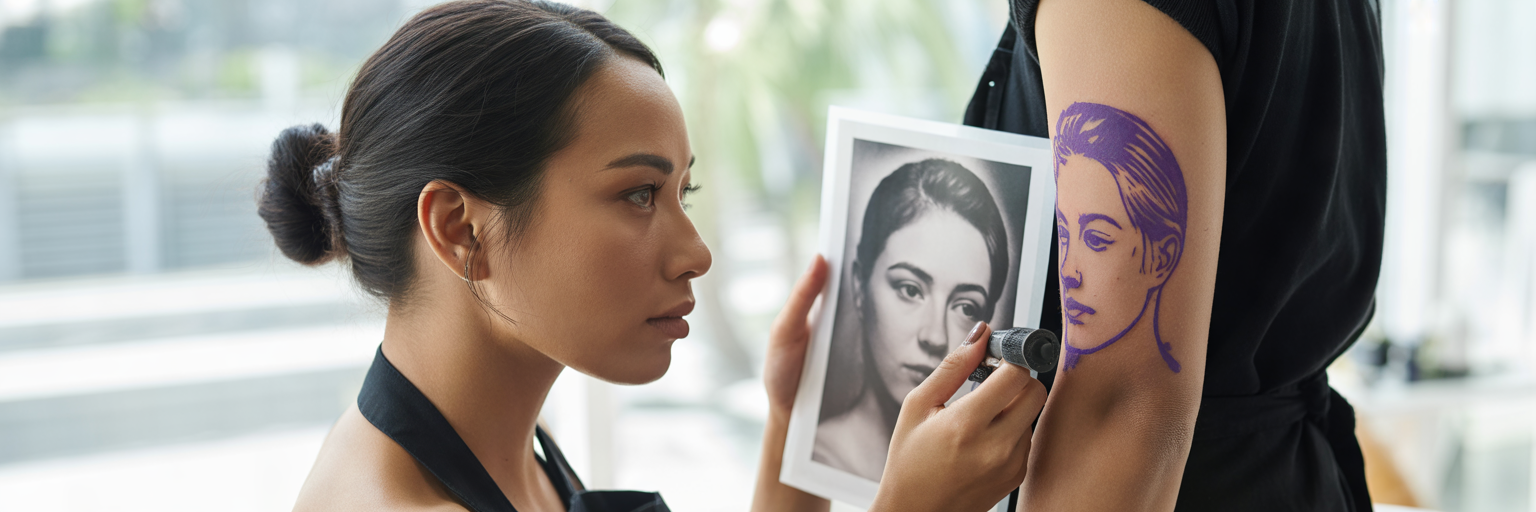
True facial likeness is anchored in exact geometric relationships. The precise distance between the tear ducts, the subtle tilt of the mouth, and the angle of the jawline must be verified against the reference photograph before tattooing begins. Clients sometimes feel surprised during the consultation when they first see the purple stencil applied to their skin, expecting a fully shaded pencil drawing. In reality, a realism stencil functions as a topological map outlining feature placement and shadow boundaries rather than a literal rendering of textures. Understanding this technical step helps you evaluate the placement with total confidence.
Balancing Deep Blacks and Open Skin in Humid Climates
To give a black and grey portrait lifelike volume, we apply the discipline of value mapping, dividing the face into dark shadow cores, smooth mid-tones, and protected highlights. Leaving open skin as negative space for bright highlights is far superior to over-relying on opaque white ink. Uninked skin allows the portrait to breathe and age gracefully, which is especially vital when maintaining tattoo vibrancy in the tropics where Singapore's year-round humidity and sun exposure test dermal contrast.
| Tonal Zone | Primary Anatomical Areas | Tattooing Technique | Long-Term Aging Function |
|---|---|---|---|
| Deep Shadow Cores | Pupils, nostril base, lash lines, neck creases | Solid black saturation | Anchors structural contrast and prevents fading into a blur |
| Structured Mid-Tones | Cheekbone contours, temple slopes, jawline | Layered diluted grey washes | Creates smooth three-dimensional curvature and volume |
| Soft Transitions | Forehead planes, philtrum, under-eye hollows | Gentle whip shading with curved magnums | Connects dark and light zones without harsh outlines |
| Protected Highlights | Nose bridge, tear duct catchlights, lower lip center | Uninked negative skin space | Preserves natural luminosity and allows skin to breathe |
This breakdown illustrates how professional realism artists divide a reference photograph into distinct tonal roles based on standard anatomical light behavior and dermal pigment settling over time. When these four zones work in harmony, the portrait maintains its three-dimensional depth for decades without relying on harsh outlines.
Capturing Authentic Emotion Through Subtle Asymmetries
Once the geometric stencil and tonal boundaries are locked in, the artistry turns toward the delicate nuances that transform an accurate likeness into a deeply moving tribute.
Honoring Natural Quirks Over Idealized Symmetry
Human emotion rarely lives in perfection. It resides in fleeting micro-expressions and subtle imperfections that make a face instantly recognizable to the people who love them. While it is tempting to smooth out every fine line to flatter a subject, erasing those natural textures can accidentally strip away their warmth and personality. During our design review, we pay special attention to four facial markers that carry the heaviest emotional weight:
- The orbital muscle crinkle around the outer corner of the eye that distinguishes a genuine, joyful laugh from a polite pose.
- The slight asymmetry in how the corners of the mouth rest, which often holds a person's signature sense of humor or quiet stoicism.
- The unique catchlight shape inside the iris that reflects the surrounding environment and gives the gaze an immediate sense of presence.
- The natural furrow between the brows that conveys deep thought, protective strength, or tender concern.
Creating Lifelike Depth in the Eyes
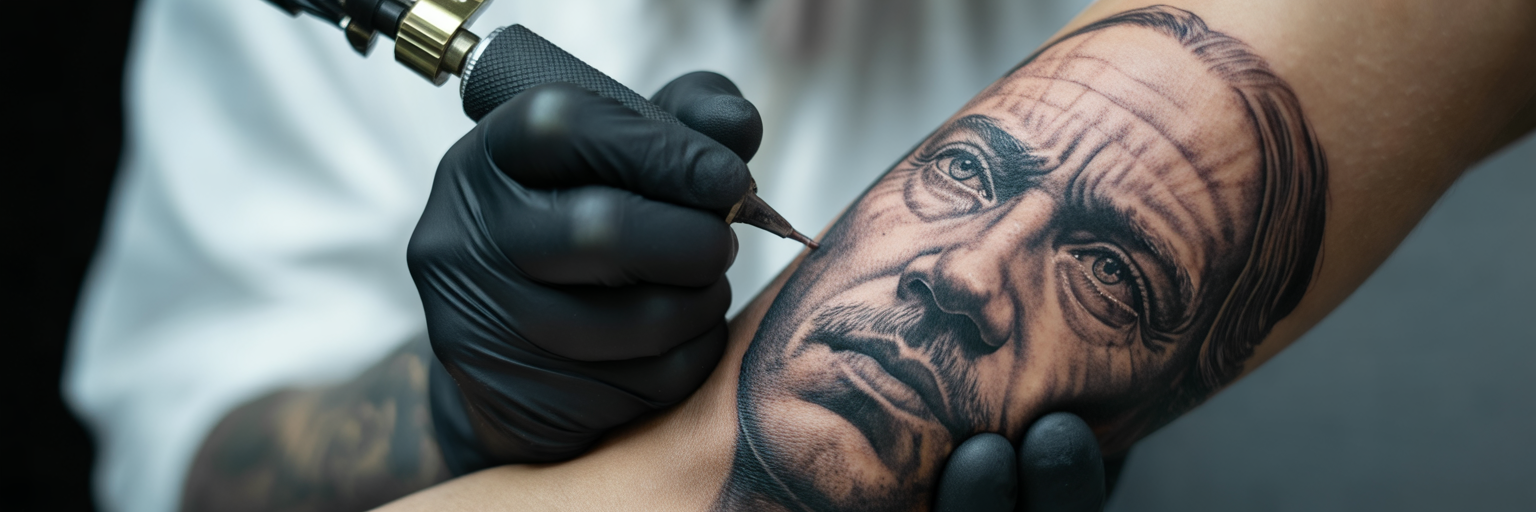
To make those subtle asymmetries feel alive, the artist must establish rich contrast right where the viewer connects with the portrait. Saturating deep, velvety blacks inside the pupils and along the upper lash line creates a striking visual spark next to the uninked catchlight. Achieving this delicate balance requires immense technical control. By utilizing sterile, single-use curved magnum needles and gentle whip shading motions, we build soft, layered gradients across the eyelids and cheeks without overworking or traumatizing your skin. Honoring natural facial quirks and mastering eye contrast is what elevates a technical drawing into a living memory.
Adapting Contrast for Body Flow and Diverse Skin Tones
Even the most expressive facial rendering must harmonize with the living canvas of your body, requiring thoughtful adaptation to your natural anatomy and complexion.
Harmonizing with Muscle Contours and Diverse Undertones
A portrait should move naturally with your body rather than fighting against it. Placing a face across a twisting joint or an uneven muscle bell can cause the features to warp whenever you shift your arm or leg. We carefully evaluate body placement for storytelling designs so the portrait sits on a stable anatomical plane and its gaze faces naturally toward the center of your body. Equally important is tailoring the tonal palette to your unique complexion. Serving Singapore's multicultural community and international clientele means adjusting our grey wash dilutions to complement warm, cool, and deeper skin undertones, expanding the mid-tone transitions and boosting dark contrast so the portrait remains clear and legible over time.
Integrating Portraits into Strategic Cover-Up Designs
For clients seeking to replace an older piece, planning a realistic portrait over existing ink requires specialized structural choreography. By positioning the dark shadow zones of flowing hair, wardrobe drapery, or atmospheric background framing directly over the old pigment, we can conceal unwanted shapes while keeping the delicate facial features on clear, uninked skin. Our experience in transforming faded tattoos into hyper-realistic art ensures that cover-up portraits never look heavy or compromised. Through ongoing communication during sizing and stencil fitting at our custom tattoo Singapore studio, we make sure every curve of the design flatters your physique. Harmonizing the artwork with your natural anatomy and skin tone guarantees that an emotional portrait remains clear, balanced, and timeless for decades to come.