
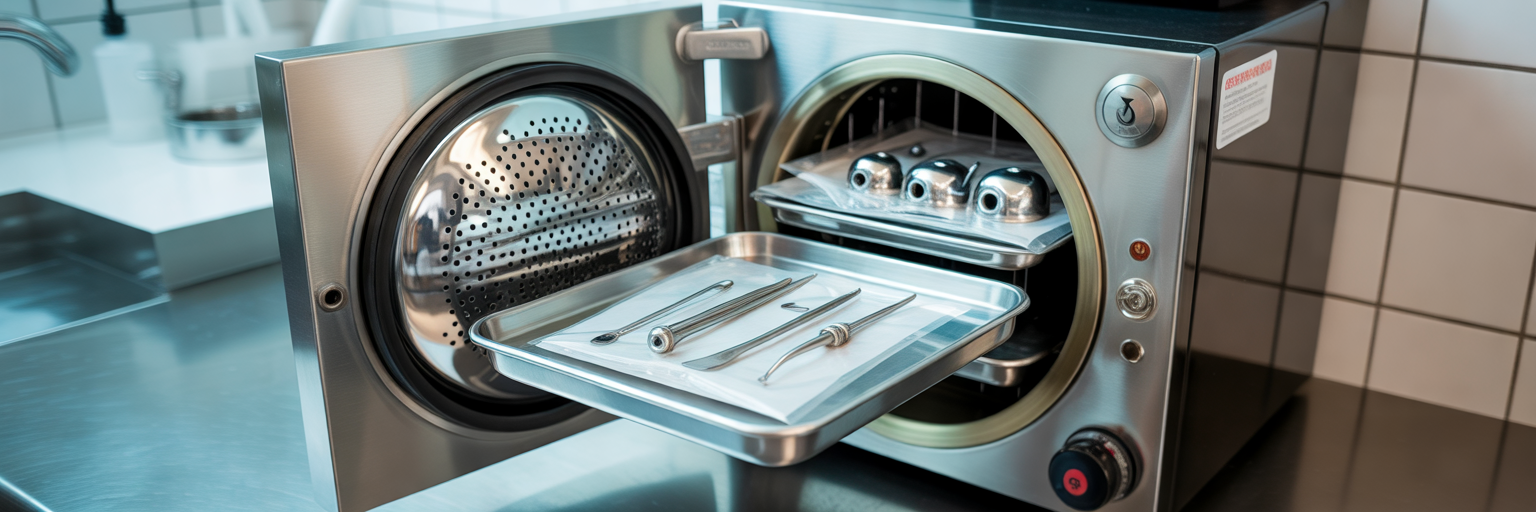
French microbiologist Charles Chamberland invented the first steam pressure sterilizer in 1879, transforming surgical medicine forever. Today, that exact physical principle protects your skin whenever you sit in a tattoo chair for custom body art. Achieving strict autoclave sterilization forms the invisible foundation of every piece we create at Memory Lane Tattoo Studio. Under the guidance of our artistic director Apple Qu, crafting a meaningful design requires a clinical environment that respects your well-being, whether we are collaborating on a delicate fine-line emblem or a complex cover-up.
How Autoclave Sterilization Protects Your Skin and Art
The Science of Steam Under Pressure
Surface disinfectants and hospital-grade wipes play a vital role in keeping workstation surfaces clean, yet they cannot eliminate every microscopic threat on metal tools. Professional benchtop autoclaves bridge this gap by locking instruments inside a sealed chamber and injecting high-pressure saturated steam. This intense thermal energy penetrates tough cellular walls to obliterate all microbial life, including bloodborne viruses, fungi, and resilient bacterial spores. When we work on sensitive skin during intricate procedures, such as those detailed in our guide to transforming faded tattoos into hyper-realistic art, knowing that every reusable tool has undergone complete microbial eradication gives both artist and client total peace of mind.
Reusable Instruments vs. Single-Use Disposables
Discerning clients often ask about custom tattoo safety and which specific items actually go inside the sterilizer. According to the New South Wales Ministry of Health guidelines on tattooing businesses, any reusable instrument used for skin penetration must be steam sterilized under pressure, whereas hollow needles must remain strictly single-use. Solid stainless steel instruments, such as heavy metal grips, tubes, and the precision forceps required for safe body piercing Singapore clients trust, are engineered to withstand repeated thermal cycles. Conversely, items that directly puncture the skin are never reused or placed in an autoclave. As we explain in our article on why single-use needles are essential, every needle cartridge is opened fresh in your presence and discarded into a medical sharps container immediately after your session. Understanding this clear boundary allows you to relax in the chair and focus entirely on the creative collaboration.
The Pre-Sterilization Cleaning and Packaging Workflow
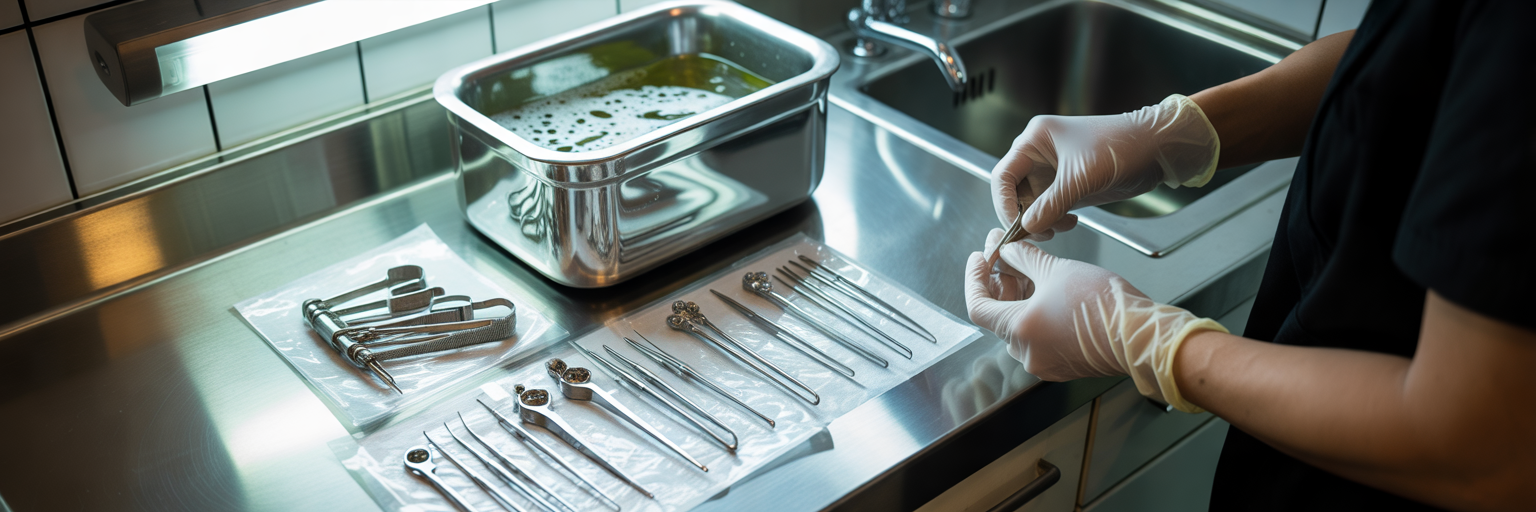
Even the most advanced hospital sterilizer will fail if an instrument enters the chamber dirty. We hold a firm conviction that sterilization is impossible without meticulous prior decontamination. If dried pigment or organic protein remains on stainless steel, it forms an insulating physical barrier that shields pathogens from pressurized steam.
Ultrasonic Cleaning and Organic Debris Removal
Before the autoclave door ever closes, reusable steel tools go through a dedicated multi-stage decontamination area. Technicians first submerge and manually scrub instruments to loosen surface residue, a critical step highlighted in the Ministry of Health guidelines for tattooing. Next comes ultrasonic tattoo cleaning, where tools are submerged in a specialized tank that pulses high-frequency sound waves through an enzymatic solution. These sound waves generate millions of microscopic cavitation bubbles that implode against the metal, stripping away hidden organic debris from textured grips and tiny crevices that manual brushes could never reach. As noted in the NSW Health factsheet on cleaning and sterilizing reusable equipment, thorough ultrasonic processing under the AS 5369:2023 standard is mandatory to ensure instruments are completely free of matter before steam exposure.
- Immediate post-session enzymatic soak to prevent organic proteins and pigments from drying onto the steel surface.
- Manual scrubbing under submerged conditions using medical detergents while keeping tools below the waterline to prevent aerosol droplets.
- Ultrasonic cavitation bath to dislodge microscopic particles from complex hinges, serrations, and tube interiors.
- Lint-free drying and visual inspection under bright magnification to verify zero residual debris or moisture remains.
- Sealing in indicator pouches stamped with reactive chemical ink that shifts color only when exposed to sterilizing temperatures.
Medical-Grade Packaging and Tropical Humidity Considerations
Once dried, instruments are sealed inside medical-grade sterilization pouches that act as a sterile barrier against airborne bacteria until the exact moment your artist opens them at the workstation. Operating in Singapore requires special attention to our warm, humid climate, which affects everything from how we store sealed instrument pouches to the advice we share in our guide on maintaining tattoo vibrancy in the tropics. Because high ambient moisture can challenge long-term pouch storage if left unchecked, top studios increasingly favor pre-sterilized, single-use disposable grips for daily tattooing. This approach eliminates cross-contamination variables altogether while reserving our rigorous autoclave workflow for specialized heavy steel tubes and bespoke body piercing instruments.
Comparing Vacuum-Assisted and Non-Vacuum Autoclaves
Not all steam sterilizers are engineered equally. Selecting the right class of machine determines whether steam actually reaches the interior surfaces of packaged body art tools.
Why Active Air Removal Matters for Hollow and Wrapped Tools
Picture trying to pour water into a narrow drinking straw while holding your finger tightly over the bottom opening. The trapped air inside creates a pocket of resistance that stops the liquid from entering. The exact same physics apply inside an autoclave chamber when sterilizing hollow tattoo tubes, piercing cannulas, or tools sealed inside medical pouches. Basic gravity displacement units, known as Type N autoclaves, rely on incoming steam to passively push ambient air downward. As detailed in the Solihull Metropolitan Borough Council 2026 Tattooing Safety Checklist, non-vacuum Type N units must only be used for unwrapped, solid instruments because trapped air pockets prevent proper steam contact inside wrapped or hollow items. In contrast, Type B vacuum-assisted autoclaves use a mechanical pump to actively pull all air out of the chamber before injecting steam, forcing pressurized heat into every millimeter of a sealed pouch or narrow steel lumen.
Meeting International Clinical Benchmarks
Adhering to high-level tattoo studio hygiene standards means aligning studio equipment with modern clinical reprocessing benchmarks like AS 5369:2023 and EN 13060. Below is how international classifications define each unit:
| Autoclave Class | Air Removal Mechanism | Approved Instrument Load | Suitability for Wrapped & Hollow Tattoo Gear |
|---|---|---|---|
| Type B (Vacuum-Assisted) | Fractionated pre-vacuum pump | Hollow tubes, porous loads, wrapped pouches, solid tools | Ideal clinical standard for full tattoo and piercing workflows |
| Type S (Specified) | Manufacturer-specific vacuum or pressure pulse | Specific loads defined and validated by the manufacturer | Acceptable only if explicitly rated for hollow and pouched tools |
| Type N (Non-Vacuum) | Passive gravity displacement | Unwrapped, solid, non-hollow metal instruments only | Unsuitable for sealed pouches or hollow steel tattoo tubes |
Investing in Type B vacuum technology eliminates safety blind spots inside the sterilization room. When you commit to a multi-hour session for an intricate custom piece, such as the designs explored in our showcase of fusion tattoos blending Eastern and Western styles, hospital-grade air removal guarantees that every pouched tool opened beside you is clinically sterile inside and out.
Spore Testing, Validation, and Transparency in the Studio
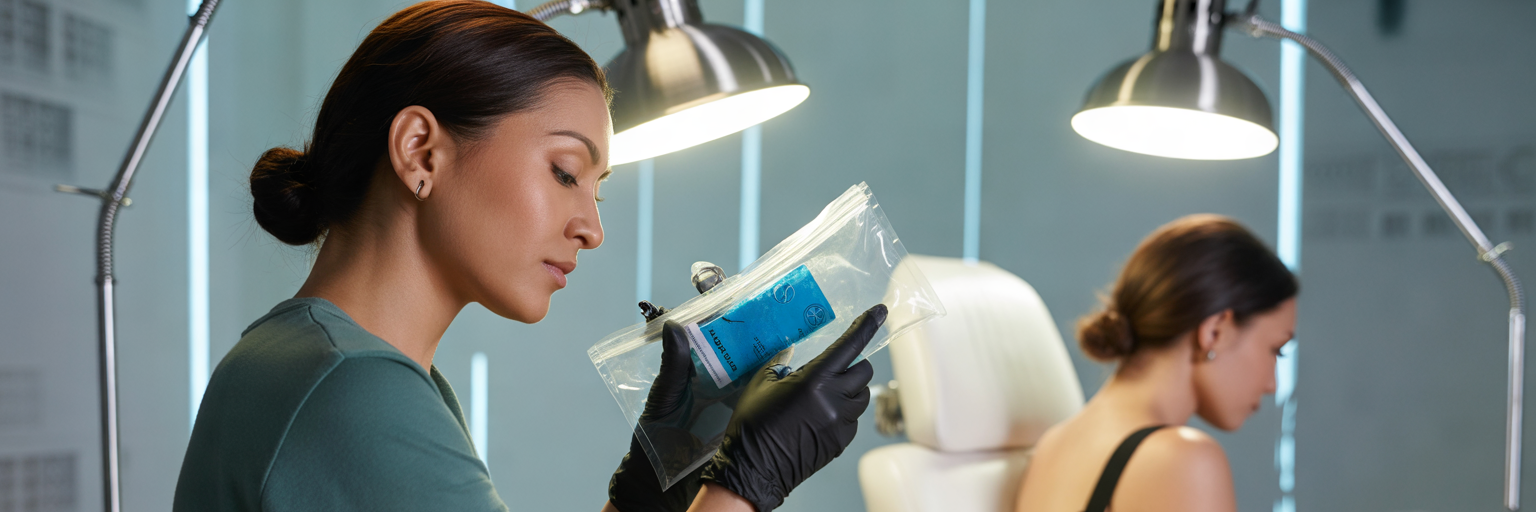
Owning clinical hardware is only half the equation. True safety relies on continuous verification to prove the equipment performs flawlessly every single week.
Biological Indicators and Routine Engineering Audits
While the chemical strips printed on sterilization pouches change color to confirm heat arrived inside the chamber, they alone cannot prove microbial lethality. That requires a rigorous spore testing tattoo verification protocol using biological indicators. According to the County of San Diego Department of Environmental Health Body Arts Practitioner's Guide, periodic spore tests utilizing vials or strips of live, highly heat-resistant microorganisms such as Geobacillus stearothermophilus must be processed alongside normal instrument loads and sent to an independent laboratory to verify complete destruction. Behind the scenes, our sterilization monitoring follows four strict tiers:
- Daily cycle parameter verification checking digital printouts and logs for exact temperature, pressure, and holding time metrics on every load.
- Weekly steam penetration tests using Bowie-Dick or Helix test devices to confirm the vacuum pump removes air rapidly and evenly from hollow loads.
- Routine biological spore testing cultured and certified by accredited third-party microbiology laboratories.
- Annual engineering calibrations performed on-site by certified biomedical technicians to validate sensors, valves, and chamber seals.
Auditable Logs and Open Client Consultations
Accountability requires meticulous documentation. Responsible studios maintain auditable sterilization logs for a minimum of 12 months, recording every cycle number, operator signature, pouch batch code, and spore test certificate. Our protocol is uncompromising: if any physical, chemical, or biological indicator ever signals an anomaly, autoclave operations stop immediately, affected instrument batches are quarantined, and the machine undergoes engineering clearance before returning to service. We encourage you to ask about our sterilization records when preparing for a tattoo cover-up consultation or planning a new custom piece. Transparency builds the trust needed for great art, and we invite you to connect with our artists at Memory Lane Tattoo Studio to begin designing your next tattoo or body piercing in a welcoming, clinically safe environment.